

Los Angeles is best tackled in clusters, not as one giant sightseeing loop. Start with Hollywood and Griffith Park, give the coast its own day, then use Downtown and Museum Row as compact cultural blocks. The best trips mix movie history, beaches, museums, viewpoints, food halls, neighborhoods, and one big studio experience rather than chasing landmarks across traffic all day.


What are the best things to do in Los Angeles?
- First trip: prioritize Griffith Observatory, Hollywood, Santa Monica, Venice, the Getty Center, Museum Row, and Downtown.
- Best free-heavy day: combine Griffith Park with Hollywood or build a Downtown walking day around Grand Avenue, Olvera Street, and Little Tokyo.
- Best movie-focused day: Hollywood Boulevard plus a working studio tour beats spending the whole day hunting celebrity homes.
- Best coastal day: keep Santa Monica and Venice together rather than driving back and forth across Los Angeles.
- Best transport strategy: walk within each cluster, use Metro where it lines up well, and save a car or rideshare for awkward cross-town connections.
- Best rule: don’t underestimate distance. Two places that look close on a map can become an annoying cross-city transfer once LA traffic enters the calculation. Discover Los Angeles likewise organizes short trips around Downtown, Hollywood, and the coast rather than treating the city as one compact center.
Where are these Los Angeles attractions on the map?
Los Angeles spreads farther than first-time visitors expect, so geography should decide your itinerary. Use the map to understand the major clusters first; then choose attractions that sit near one another instead of zigzagging between the coast, Hollywood, and Downtown.
What should you see around Hollywood and Griffith Park?
Hollywood and Griffith Park work best as one broad sightseeing zone, although the hills make walking between every stop unrealistic. This is where first-time visitors get movie history, skyline views, hiking, architecture, and several of the most recognizable Los Angeles landmarks without crossing the entire city.
| Area | Best for | Transport that usually makes sense |
|---|---|---|
| Griffith Park | Views, hiking, outdoors | Car, rideshare, shuttle where available |
| Hollywood Boulevard | Film landmarks | Walking + Metro |
| Runyon Canyon | Hiking, city views | Walking once nearby |
| Los Feliz | Architecture, quieter cultural stops | Car, rideshare, local bus |
1. Griffith Observatory
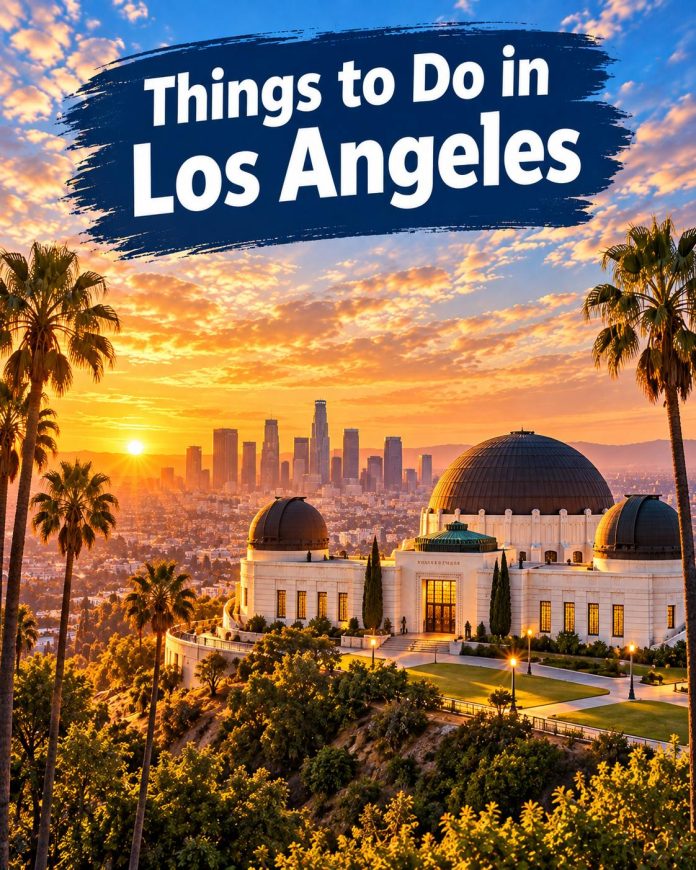
Few places explain Los Angeles as quickly as Griffith Observatory. You see the Hollywood Sign on one side, the city basin stretching below, and Griffith Park wrapping around the building. Inside, astronomy exhibits shift the visit from viewpoint to proper attraction. Admission to the observatory itself is free, though some experiences have separate charges.
It is one of the strongest choices when you want outdoor things to do in Los Angeles without committing to a long wilderness hike. The trade-off is access: parking pressure can make the final approach more annoying than the attraction itself. I would rather arrive with extra time and enjoy the hill than build a tight schedule around it.
2. Hollywood Sign from Lake Hollywood Park
The Hollywood Sign is better treated as a viewpoint target than a monument you need to stand directly beneath. Lake Hollywood Park gives you a recognizable sign view without turning the whole morning into a steep hike.
The mistake is assuming every online photo was taken from Hollywood Boulevard. It wasn’t. The sign sits high in the hills, and the street geometry changes constantly as you approach it. For couples looking for a relaxed photo stop, this is more pleasant than spending an hour circling residential roads.
3. Hollywood Walk of Fame
The Hollywood Walk of Fame is famous enough that most first-time visitors will go anyway. That’s fine. Just don’t mistake fame for atmosphere.
The interesting part is spotting names you actually care about while moving between theaters and old entertainment buildings. The disappointing part is the busiest blocks, where crowds, souvenir shops, costumed characters, and traffic can overwhelm the film history. I would give it a focused walk, not half a day. If you’re searching for things to do in Los Angeles alone, it also works because you can move at your own pace and leave whenever the novelty wears off.
4. TCL Chinese Theatre
TCL Chinese Theatre gives Hollywood Boulevard something the surrounding souvenir strip often lacks: a real sense of movie history. The courtyard handprints and footprints turn screen names into something physical, while the building itself carries the theatrical excess people expect from old Hollywood.
Spend more attention on the forecourt than on hunting every celebrity star nearby. That’s where the visit becomes specific rather than generic. Discover Los Angeles places the theater among the core Hollywood Boulevard attractions alongside the Walk of Fame.
5. Hollywood Bowl
Seeing the Hollywood Bowl empty and attending a show there are two different experiences. The real payoff comes when the amphitheater is operating as a performance venue and the hills become part of the setting.
For adults planning Los Angeles at night, I would choose one strong live event over several mediocre nightlife stops. The Bowl does require advance planning when a popular artist is playing, and transportation around showtime can be awkward. Still, it feels far more connected to the city’s entertainment identity than another generic rooftop bar.
6. Runyon Canyon Park
Runyon Canyon is less about escaping civilization and more about hiking above it. Trails climb quickly enough to open views across Hollywood toward the broader city, so you get exercise and orientation at once.
Go expecting sun, exposed sections, dogs, locals, and other hikers rather than solitude. That social feel is part of Runyon’s identity. On a shorter Los Angeles trip, it earns its place because you can combine movement and sightseeing rather than sacrificing half a day to a distant trail.
7. Barnsdall Art Park and Hollyhock House
Barnsdall Art Park gives you a different version of Hollywood: architecture, lawns, city views, and Frank Lloyd Wright rather than movie premieres. Hollyhock House is the architectural anchor, but the hilltop setting is why the stop works even for travelers who aren’t architecture obsessives.
This is the sort of place I would add when the usual Hollywood checklist starts feeling too commercial. It also pairs well with Los Feliz, making it useful for travelers trying to find more unusual things around Los Angeles without driving into another region.
Which Los Angeles beaches and Westside attractions deserve a full day?
Give the Westside and coast a dedicated block. Santa Monica and Venice combine naturally, while the Getty Center belongs farther inland and is better treated as a major stop rather than something squeezed between beach photos.
8. Santa Monica Pier
Santa Monica Pier is touristy, but unlike some famous attractions, its setting still does most of the work. Walk to the end, look back at the coastline, watch the amusement rides, then decide how much of the commercial side you actually want.
Families looking for fun things around Los Angeles will get more from the pier than travelers seeking a quiet beach. Arrive for the ocean first. Treat everything else as optional. Santa Monica Pier remains one of the region’s most heavily visited coastal landmarks.
9. Santa Monica State Beach
The beach beneath and around the pier is broad enough that you can escape some of the pier congestion quickly. That contrast is why I wouldn’t treat the pier and beach as the same attraction.
Walk the sand, use the paved path, or stay until the light softens toward evening. For cheap things to do around Los Angeles, the coast is hard to beat once transportation and parking are handled. The beach also gives kids room to move after museums or long car rides.
10. Venice Beach Boardwalk
Venice is messy, creative, commercial, athletic, eccentric, and occasionally exhausting. That’s exactly why it belongs on the list.
The Boardwalk works best when you keep moving: street performers, murals, shops, Muscle Beach, skateboarders, and the ocean all compete for attention. Don’t expect a polished resort strip. Venice is strongest when you accept the friction. If Santa Monica is easier, Venice is more memorable.
11. Venice Canals
Move inland from the beach and Venice changes almost immediately. The canals bring footbridges, narrow pedestrian paths, homes facing the water, and a pace that feels detached from the Boardwalk a short distance away.
This is one of the better romantic stops in Los Angeles because it doesn’t require buying anything or dressing up for a reservation. Keep voices down and remember that people actually live here. The canals are a neighborhood first and a sightseeing stop second.
12. Abbot Kinney Boulevard
Abbot Kinney works when you want Venice without sand in your shoes. Restaurants, independent shops, coffee counters, design stores, and street life make it an easy transition between the canals and beach.
I wouldn’t cross Los Angeles solely to shop here. But as part of a Venice day, it adds texture and gives you somewhere to slow down. It’s especially useful when coastal wind or afternoon crowds make another hour on the Boardwalk less appealing.
13. Getty Center
The Getty Center earns several hours, not a rushed photo stop. Art galleries, Richard Meier’s architecture, gardens, terraces, and views compete for your attention, so museum fatigue is less of a problem than at buildings where every hour happens indoors.
Admission is currently free with timed entry required, while parking is separate. If you’re trying to do Los Angeles on a budget, that makes the Getty unusually strong value. My preference is to leave room for the Central Garden instead of spending every minute inside galleries.
14. Getty Villa
The Getty Villa feels completely different from the Getty Center. Its focus on Greek and Roman antiquities suits the reconstructed Roman-country-house setting, while courtyards and gardens slow the pace.
It sits along the coast in Pacific Palisades, so geography matters. Don’t casually add it to a Downtown day because both museums carry the Getty name. The Getty itself presents the Villa as a separate destination west of the Center.
15. Palisades Park
Palisades Park runs along the bluff above Santa Monica’s coastline, giving you ocean views without immediately dropping down to the sand. Palm trees, lawns, benches, and overlook points make it a useful reset between busier stops.
If you only have one day in Los Angeles and choose the coast, walking through the park before or after the pier creates a better sense of place than staying inside the amusement area. Small decision. Big improvement.
What should movie and museum fans do around Museum Row?
The Wilshire corridor packs film, art, cars, fossils, food, and shopping into a relatively tight area. It is one of the easiest places to build an indoor-heavy day when heat, rain, or museum interests matter more than beaches.
16. Academy Museum of Motion Pictures
The Academy Museum is where I’d send someone who wants movie history without the chaos of Hollywood Boulevard. Costumes, production design, filmmaking, directors, technology, and changing exhibitions turn film into a craft rather than a celebrity scavenger hunt.
It is particularly good for first-time visitors who know Hollywood through movies but don’t necessarily care about stars on a sidewalk. Leave time for the building itself and its viewpoints instead of sprinting exhibition to exhibition.
17. Los Angeles County Museum of Art
LACMA belongs on an art-focused itinerary even when construction and gallery changes mean you need to check current access before arriving. The recognizable Urban Light installation makes the campus worth seeing even for visitors who don’t plan a long museum session.
The smarter move is combining LACMA with the Academy Museum and La Brea Tar Pits rather than treating each as a separate cross-town mission. Discover Los Angeles continues to place LACMA among the city’s major cultural attractions.
18. La Brea Tar Pits
La Brea Tar Pits is one of those rare attractions where the location itself is the scientific story. Fossils from Ice Age animals came from asphalt deposits in the middle of what is now a dense city neighborhood.
Kids tend to understand the appeal instantly, but adults shouldn’t dismiss it as a children’s stop. Seeing paleontology tied directly to the ground outside makes it far more concrete than another room of fossils behind glass.
19. Petersen Automotive Museum
Even people who don’t identify as car enthusiasts can understand the Petersen. Los Angeles was shaped by automobiles, freeways, design, racing, movie cars, and the strange freedom and frustration that come with driving here.
The museum leans into that connection. If you’re looking for indoor things to do in Los Angeles on a rainy day, this is one of the strongest substitutes for a beach or hike because it still feels specific to the city.
20. Original Farmers Market
The Original Farmers Market works because everyone in a group can want something different and still eat together. Counters and stalls cover far more ground than a single restaurant, which is useful when you’ve spent hours inside nearby museums.
Don’t confuse it with a quiet weekly produce market. This is a long-established food and shopping destination. I would use it as the meal stop between cultural attractions rather than making a complicated reservation across town.
21. The Grove
The Grove is polished, manicured, and commercial. That’s either the appeal or the reason to skip it.
It works best paired with the Farmers Market, especially if your group wants shopping, an easy evening stroll, or a break from museums. Travelers looking for unique Los Angeles culture won’t find it as revealing as Little Tokyo or Venice. Travelers who want an easy, comfortable stop may love it.
What are the best things to do in Downtown Los Angeles?
Downtown gives you one of LA’s rare opportunities to stack several attractions without repeatedly getting into a car. Grand Avenue, the Historic Core, El Pueblo, Union Station, Little Tokyo, Chinatown, and the Arts District each have distinct character, so don’t reduce DTLA to skyscrapers.
22. Walt Disney Concert Hall
Frank Gehry’s Walt Disney Concert Hall is worth walking around even if you don’t have a concert ticket. The metal curves change as you move, and the surrounding Grand Avenue cultural district gives the building context.
But the stronger experience is hearing music inside. If your schedule allows it, look for a performance rather than treating the hall as an exterior photo stop. Discover Los Angeles places it at the center of Downtown’s cultural circuit.
23. The Broad
The Broad’s contemporary collection makes sense even for visitors who usually find large art museums intimidating. You can encounter major postwar and contemporary names without navigating an encyclopedic collection covering thousands of years.
Its position opposite Disney Concert Hall is a gift. Pair them. Add MOCA if you still have energy. That compact Grand Avenue triangle is one reason Downtown works so well for culture without a car.
24. MOCA Grand Avenue
MOCA gives contemporary-art fans another reason to stay on Grand Avenue. Compared with The Broad, it can feel less like a headline attraction and more like a museum you enter because you’re genuinely interested in what is on view.
That’s not a weakness. If crowded blockbuster spaces wear you out, MOCA can be the better experience. Check the current exhibition program before visiting rather than assuming every gallery will appeal equally.
25. Grand Central Market
Grand Central Market solves the classic group problem: nobody agrees what to eat. Walk the aisles, compare counters, and let people split up before regrouping.
It’s busy because it is useful, not because someone designed it as a sightseeing set. That matters. For travelers squeezing Los Angeles into three days, a food hall lets you eat something memorable without sacrificing a long block to formal dining.
26. Angels Flight Railway
Angels Flight is tiny, historic, and delightfully specific. The short funicular railway links two levels of Downtown and turns what could be a forgettable elevation change into a piece of LA history.
Don’t build your day around it. Do ride it when you’re already moving between Grand Central Market and the Bunker Hill cultural district. That’s the right scale for the experience.
27. The Last Bookstore
The Last Bookstore gives Downtown a useful pause from museums and architecture. Books, used titles, art spaces, and photo-friendly installations fill a historic building that feels far less predictable than a standard retail stop.
Go because you like bookstores, not because social media told you to photograph one arch. The pleasure is browsing long enough to forget what time it is.
28. Olvera Street and El Pueblo
Olvera Street belongs to the oldest part of the city, where the Los Angeles story predates freeways and movie studios. The pedestrian lane is compact, colorful, commercial, and surrounded by historic buildings and cultural institutions.
Walk beyond the souvenir stalls. Avila Adobe and the broader El Pueblo area give the stop historical weight. For free things to do in Los Angeles, this district offers far more context than another viewpoint.
29. Los Angeles Union Station
Union Station still feels ceremonial in a way modern transport hubs rarely do. Its waiting room, courtyards, tile, wood, and blend of architectural influences make it worth entering even if you’re not catching a train.
It also acts as a practical hinge between Olvera Street, Chinatown, Little Tokyo, Metro lines, regional rail, and buses. Sometimes the most useful building on a sightseeing day is also one of the best-looking.
30. Japanese Village Plaza in Little Tokyo
Little Tokyo deserves more than a meal stop, but Japanese Village Plaza gives first-time visitors an easy center of gravity. Food, sweets, groceries, gifts, and surrounding cultural institutions make the neighborhood simple to explore on foot.
This is one of my preferred stops when a Downtown itinerary starts becoming too monument-heavy. Eat something, browse slowly, then continue through the wider district instead of treating the plaza as a self-contained attraction.
31. Arts District
The Arts District rewards wandering more than checklist sightseeing. Murals, converted industrial buildings, galleries, cafés, shops, restaurants, and old loading-dock architecture create a neighborhood where the spaces between destinations matter.
Don’t arrive expecting every block to be packed with attractions. That’s the wrong test. Give yourself a loose route and let the district work as a neighborhood rather than an amusement zone.
32. Chinatown Central Plaza
Chinatown Central Plaza is compact enough to add after Union Station or before heading deeper into Downtown. Its gates, businesses, restaurants, old neon, plazas, and surrounding streets offer another layer of LA’s immigrant history.
The useful insight is not to race between Little Tokyo and Chinatown because both are “Asian neighborhoods.” They have separate histories and moods. Give each enough time to become more than a meal.
What should families and culture travelers see around Exposition Park?
Exposition Park lets you combine major museums, gardens, sports history, and USC-area architecture without crossing town between every stop. The Metro E Line serves the area, making this one of the more practical car-free sightseeing clusters.
33. Natural History Museum of Los Angeles County
Dinosaurs will pull families through the door, but the Natural History Museum covers much more than giant skeletons. Southern California’s natural and cultural history gives the museum a local dimension that generic science centers sometimes lack.
With kids along, the calculation changes: one substantial museum plus outdoor time usually works better than forcing three institutions into the same day. Exposition Park makes that easy because the next break can happen outside.
34. California Science Center
The California Science Center is built for curiosity rather than quiet observation. Interactive science, technology, ecosystems, and large-scale exhibits make it especially useful for families who need something more active than another art gallery.
Because major exhibition areas can change, check current access before your visit. The bigger advantage is location: the Science Center sits inside Exposition Park alongside other major cultural institutions.
35. California African American Museum
CAAM brings African American art, history, and culture into the Exposition Park cluster, which makes it easy to diversify a museum day without changing neighborhoods.
I would rather visit two institutions with different perspectives than three that cover similar ground. CAAM provides exactly that contrast. Check the current exhibition calendar because temporary shows can significantly shape the experience.
36. Los Angeles Memorial Coliseum
The Coliseum carries layers of sports history that extend far beyond one team or era. Even from outside, its scale and peristyle give Exposition Park a monumental edge.
Sports fans will get the most from a tour or event when available, but the stadium still works as part of a walking loop through the park. With Los Angeles preparing for another Olympic chapter, the building’s long relationship with major events only feels more relevant.
37. Exposition Park Rose Garden
The Rose Garden is the decompression zone between large attractions. After hours of display cases, galleries, or interactive exhibits, sitting outside can improve the rest of your day more than adding another ticketed stop.
It’s particularly useful in summer when you want to alternate indoor museums with open space. A good Los Angeles itinerary needs recovery time. This is one of the easiest places to build it in.
Which Los Angeles studio experiences are actually worth planning around?
A real studio or theme-park day can justify the travel and ticket cost when movies are central to your trip. Pick one major studio experience rather than booking several similar tours back-to-back; the production context is interesting, but repetition arrives faster than most visitors expect.
38. Universal Studios Hollywood
Universal Studios Hollywood combines a working-studio identity with a full theme park, so this is the choice for travelers who want rides and film-world spectacle rather than a quiet behind-the-scenes tour.
Give it substantial time. Trying to “fit Universal in” before Hollywood Boulevard usually produces an expensive half-day where you’re watching the clock. The park remains one of LA Tourism’s headline attractions.
39. Warner Bros. Studio Tour Hollywood
Warner Bros. offers the more focused studio-tour route. Instead of spending the day moving between theme-park rides, you’re there for sets, soundstages, props, production history, and the mechanics behind familiar films and television.
For serious movie fans, I prefer this style because the working-studio context is the point rather than a side attraction. Availability and what you can see can vary with production, so avoid assuming a particular set will always be accessible.
40. Paramount Pictures Studio Tour
Paramount gives movie fans something Warner Bros. and Universal cannot: a major working studio sitting directly in Hollywood. The famous gate, soundstage environment, and production history connect modern filmmaking with the neighborhood’s older studio era.
This is where I would end a film-heavy Los Angeles trip. After the Walk of Fame, Chinese Theatre, Academy Museum, and a working studio, you’ve seen Hollywood from four different angles instead of repeating the same celebrity story.
Frequently Asked Questions
What is Los Angeles best known for?
Los Angeles is best known for Hollywood and the film industry, Pacific beaches, major museums, diverse neighborhoods, hillside views, live entertainment, food from communities across the world, and its car-oriented geography. The city makes more sense when you experience several of those identities rather than spending an entire trip around Hollywood Boulevard.
How many days do you need in Los Angeles?
Three days gives you a useful introduction if each day stays geographically focused. Four or five days is far more comfortable for combining Hollywood, the coast, Downtown, museums, and a studio or theme park without constantly rushing. Longer stays also make neighborhood dining and slower beach time much easier.
Is Los Angeles worth visiting without a car?
Yes, but your itinerary needs more discipline. Metro works well for selected corridors and several major attractions, while walking is practical within Downtown, Hollywood, Santa Monica, and individual neighborhood clusters. A few rideshares can fill awkward gaps. Trying to cross the entire metropolitan area repeatedly is where car-free plans become tiring.
Is Los Angeles walkable for tourists?
Individual districts can be highly walkable even though Los Angeles as a whole is not. Downtown, Hollywood Boulevard, Venice, Santa Monica, Museum Row, Little Tokyo, and parts of Koreatown work well on foot. The mistake is assuming you can casually walk between those districts because they appear on the same city map.
What are good things to do in Los Angeles this weekend?
Build around one major reservation or event, then add nearby flexible stops. A Hollywood show can pair with Griffith Park, a Downtown museum booking can lead into Grand Central Market and Little Tokyo, while a coastal weekend day can combine Santa Monica, Venice, the canals, and sunset near the ocean.
Is Los Angeles expensive for tourists?
It can be, especially once hotels, parking, theme parks, premium restaurants, and repeated rideshares pile up. Yet a good trip can balance those costs with beaches, parks, architecture walks, neighborhoods, viewpoints, and museums offering free admission. Spend heavily on the experiences that matter most and let geography reduce the rest.