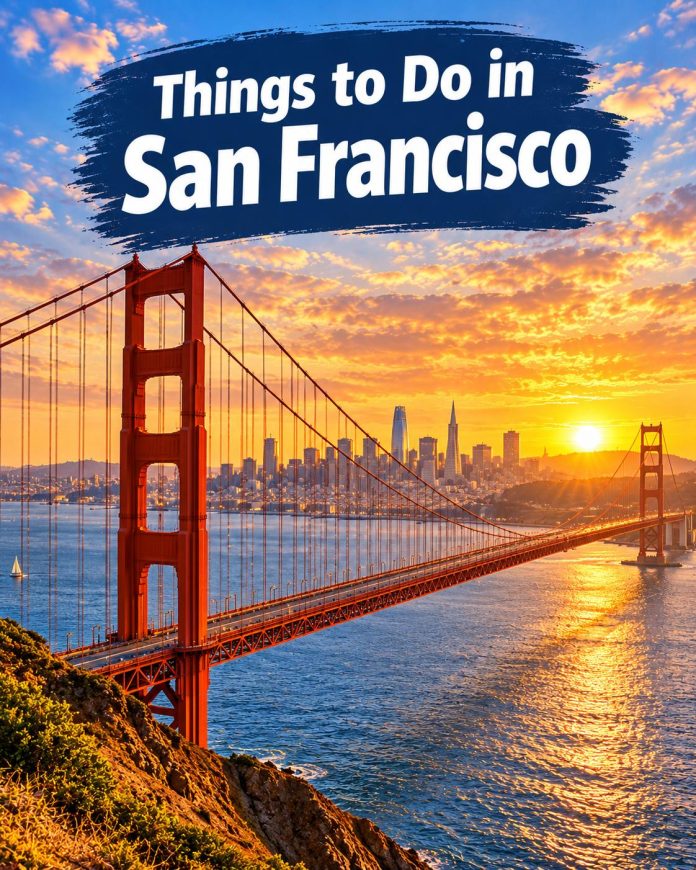


San Francisco rewards travelers who mix its icons with its neighborhoods. Start with the Golden Gate Bridge, Alcatraz and a cable car ride, then spend time in Chinatown, the Mission, the Presidio and Golden Gate Park. The best things to do in San Francisco fit together by area, not by fame.


What are the best things to do in San Francisco for a first visit?
- Put the Golden Gate Bridge, Alcatraz and a cable car ride near the top of a first trip.
- Explore neighborhoods on foot instead of treating the city as one long attraction checklist.
- Reserve Alcatraz before building the rest of your waterfront day around it.
- Use Muni, cable cars and walking for most central sightseeing; SFMTA describes the city as highly walkable and transit-connected.
- Carry a light layer even when the morning looks warm. Conditions can change sharply between the waterfront, hills and western neighborhoods.
- Group the 40 stops below geographically rather than zigzagging across town.
| Area | Best for | Easiest approach | Main trade-off |
|---|---|---|---|
| Golden Gate and Presidio | Bridge views, coast, trails | Walking, bus, rideshare | Wind and hills |
| Wharf, North Beach and Chinatown | Classic sights, food, history | Walking, cable car | Heaviest tourist traffic |
| Downtown, Embarcadero and SoMa | Museums, bayfront, architecture | Muni and walking | Less intimate than neighborhood SF |
| Mission, Castro and Haight | Local character, murals, parks | Muni and walking | Attractions are more spread out |
| Golden Gate Park and west side | Museums, gardens, ocean | Bus, bike, walking | Farther from downtown |
Where are these San Francisco attractions on the map?
Most major sights form useful clusters around the northern waterfront, downtown, the central neighborhoods and Golden Gate Park. Use the interactive map to switch between major landmarks, then build each sightseeing day around nearby stops rather than chasing isolated attractions across town.
What are the best things to do around the Golden Gate Bridge and Presidio?
The northwest corner gives you San Francisco at its most dramatic: bridge steel, military history, beaches and open bay. For outdoor things around the city, this is where I’d spend the clearest part of the day, using walking and transit rather than hunting for scarce parking.
1. Golden Gate Bridge
Walk at least part of the Golden Gate Bridge rather than treating it as a drive-through photo stop. The changing angle matters: up close, you notice the scale of the towers, cables and moving traffic, while the bay opens behind you as you walk farther from the south end.
I prefer arriving without a car. Parking around the visitor area is limited, and the bridge district actively recommends transit; its current guidance also warns that access and parking arrangements can change, particularly around busy weekends and holidays.
2. Crissy Field
Crissy Field gives you one of the easiest low-angle bridge views without needing to climb a hill. Walk the waterfront, watch sailboats cut across the bay and keep going toward Fort Point if the weather behaves. Families also get more breathing room here than at the main bridge viewing plaza.
3. Fort Point National Historic Site
Fort Point is the stop people photograph from above without realizing they can go down to it. The brick fort sits almost directly beneath the bridge, which gives you a strange and memorable mix of 19th-century military architecture and massive modern engineering overhead.
What I like most is the perspective. The bridge stops looking like a postcard and starts feeling absurdly large. Check current access before you go because conditions around historic sites can change.
4. Presidio Tunnel Tops
Presidio Tunnel Tops connects landscaped open space with broad views toward the bay and bridge. It works especially well when you’re traveling with kids or mixed-age groups because you can stop, sit and recover without committing to another museum, trail or long climb.
5. Palace of Fine Arts
The Palace of Fine Arts looks almost unreal against its residential Marina surroundings. Walk the lagoon and colonnade instead of stopping only for the standard front-facing photograph.
Early or quieter parts of the day suit it best. Later, photo shoots and tour groups can dominate the obvious viewpoints. The architecture is the reason to come, but the calm loop around the water is what makes the stop feel worthwhile.
6. Baker Beach
Baker Beach gives the Golden Gate Bridge a wilder setting, with surf, sand and cliffs replacing the paved visitor plaza. It can be cold even when another part of town feels pleasant, so this is one of those San Francisco stops where carrying an extra layer pays off.
7. Lands End
Lands End is where I send people who say they want scenery but don’t want another conventional attraction. The paths move through cypress, cliff edges and changing Pacific views, with the Golden Gate appearing and disappearing between trees.
The trade-off is simple: terrain. You’ll enjoy it more with proper walking shoes and enough time to stop rather than rushing through on the way to another reservation. If you’re searching for fun things beyond museums and shopping streets, this stretch proves how quickly San Francisco can feel almost removed from the city.
What should you do around Fisherman’s Wharf, North Beach and Chinatown?
This is the dense classic-San-Francisco cluster: ferries, sea lions, Italian-American history, steep streets and Chinatown storefronts all sit within a relatively compact zone. Walk most of it. A car adds more friction than freedom here.
8. Alcatraz Island
Alcatraz deserves its reputation, but only if you give it enough time. The ferry ride is part of the experience because the skyline slowly separates from you, then the prison complex takes over the island as you approach.
Inside, the cellhouse interpretation is stronger than the quick “famous prison” label suggests. The National Park Service advises visitors to plan on spending a couple of hours on the island; ferry tickets are required, and the cellhouse audio tour comes with the ferry ticket.
Book through the official operator rather than assuming you’ll find convenient same-day space. This is one of the few attractions I’d organize a whole waterfront day around.
9. Pier 39
Pier 39 works best when you know what you’re getting: sea lions, bay views, food, souvenir shops and heavy crowds. With kids, it can be easy entertainment. For adults chasing local character, I wouldn’t build half a day around it.
That’s my popular-stop criticism. The sea lions are fun; much of the retail experience could be in any major tourist district. See the animals, enjoy the waterfront, then keep moving.
10. Fisherman’s Wharf
Treat Fisherman’s Wharf as a district to walk through rather than one attraction to “complete.” The waterfront atmosphere, working boats and bay views make it worthwhile, but the busiest blocks are unapologetically tourist-oriented. Pair it with Alcatraz, Musée Mécanique or Hyde Street rather than giving it a separate trip.
11. Musée Mécanique
Musée Mécanique is wonderfully odd: antique mechanical games, coin-operated amusements and machines that feel completely different from polished modern arcades. It is one of my favorite unusual stops on the waterfront because it gives you something to actually do instead of another backdrop for photographs.
12. Ghirardelli Square
Ghirardelli Square is an easy add-on after the western end of the Wharf. The brick industrial buildings, shops and steep surrounding streets give it more visual character than a standard shopping center, although I’d come for the setting and a break rather than make it a major sightseeing target.
13. Coit Tower
Coit Tower is partly about the view and partly about the route there. Approaching through North Beach or the Telegraph Hill streets forces you into the city’s topography, where a short-looking map distance can turn into a serious climb.
Don’t rush straight back down. Telegraph Hill is full of stairways, gardens and odd little sightlines toward the bay. That’s often the better memory. For couples looking for a quieter shared walk, those surrounding streets feel more personal than the waterfront attractions below.
14. Washington Square
Washington Square is North Beach’s breathing space. Sit here between meals, cafés, Coit Tower and the neighborhood’s bookshops rather than racing through. It is especially useful on a packed sightseeing day because you can experience the district without buying a ticket or joining another queue.
15. Chinatown Dragon’s Gate
Enter Chinatown through the Dragon’s Gate, but don’t judge the neighborhood from Grant Avenue alone. Walk farther into side streets, markets and Stockton Street, where the rhythm feels more practical and less designed for visitors.
The mistake first-timers make is looking only for decorative architecture. Food stores, bakeries, produce markets and everyday pedestrian traffic tell you more about the neighborhood. For travelers exploring San Francisco cheaply, Chinatown also gives you hours of street-level interest without another admission charge.
What are the best things to do in San Francisco around downtown, the Embarcadero and SoMa?
Downtown sightseeing works best when you mix the waterfront with one or two substantial indoor stops. This part of town is easier by transit than by car, and it gives rainy-day visitors more flexibility than the beach-and-trail neighborhoods farther west.
16. Ride the Powell-Hyde Cable Car
Yes, ride a cable car. It is touristy because it is genuinely distinctive, not because someone invented a fake heritage experience. San Francisco still operates three cable car lines: two link Powell and Market with the Fisherman’s Wharf area, while the California line crosses Nob Hill toward Van Ness.
The detail that saves frustration is boarding strategy. Famous terminals can draw lines, so don’t assume the most photographed turnaround is automatically the smartest place to get on. Check current service, and remember that riding is the attraction; you don’t need to turn every trip into a perfect outside-platform photograph.
17. Ferry Building
The Ferry Building is my preferred waterfront food stop because it combines architecture, bay views and serious food businesses without forcing you into a formal meal. Walk through, inspect what is open, then step outside along the Embarcadero.
Don’t arrive with a rigid list of one famous item you saw online. Browse first. The better move is often whichever bakery, produce stall or prepared-food counter has something that looks good right then.
18. Exploratorium
The Exploratorium is one of the strongest choices when you need an indoor attraction that doesn’t feel like a backup plan. Hands-on exhibits reward touching, testing and lingering, which makes it especially good with older kids, curious adults or anyone tired of looking at objects behind glass.
19. Salesforce Park
Salesforce Park is an elevated green space that surprises people because of where it sits: directly above a major transit center amid downtown towers. Use it as a reset between Union Square, the Ferry Building and SoMa rather than treating it as a destination requiring half a day.
20. San Francisco Museum of Modern Art
SFMOMA is the museum I’d choose if you have room for one major art stop downtown. The building itself changes how you move through the collection, with large galleries and shifts in scale that keep a long museum visit from feeling completely flat.
Trying to “finish” a museum this size is the wrong goal. Pick the areas that interest you, allow time to sit, and leave before your attention collapses. Adults spending a rainy afternoon in the city can easily pair this with nearby Yerba Buena Gardens.
21. Yerba Buena Gardens
Yerba Buena Gardens gives downtown visitors an outdoor pause beside museums, hotels and convention activity. The lawns, landscaping and public spaces make more sense as part of a walking route than as an isolated destination, especially when you’re exploring SoMa without a car.
22. Oracle Park
Even without a game, Oracle Park’s waterfront setting is worth seeing while you’re walking the southern Embarcadero. On event days the entire area changes character, so check the schedule before assuming you’ll encounter a quiet promenade.
Baseball fans should obviously consider a game. Everyone else can enjoy the bay-facing surroundings and then continue toward Mission Bay.
What should you see in the Mission, Castro, Haight and central neighborhoods?
These neighborhoods show why checking off landmarks alone misses the point of San Francisco. Murals, parks, historic streets and residential architecture matter more here than big-ticket attractions, and walking a few extra blocks often reveals more than following the shortest map route.
23. Mission Dolores
Mission Dolores gives you a direct connection to the city’s Spanish colonial and early California history. It is a more contemplative stop than the lively Mission streets around it, which is precisely why pairing the two works.
Give the site its own attention rather than treating it as something to photograph between lunch and Dolores Park. Check current visitor access before arriving.
24. Dolores Park
Dolores Park works because the view and the people-watching are equally important. On a clear day, the slope opens toward downtown while the Mission and Castro sit within easy walking distance.
Bring food, sit for a while and resist turning the stop into another ten-minute photograph. If you’re visiting alone, this is also one of the simplest places to slow down without feeling awkward about occupying a table or buying something.
25. Clarion Alley
Clarion Alley packs a changing wall of murals into a narrow Mission passage. Art here responds to politics, community issues, identity and local life, so don’t treat it as a static outdoor gallery where every piece will remain unchanged between visits.
26. Castro Theatre
The Castro Theatre is one of the neighborhood’s defining landmarks, with its marquee acting almost like a gateway to Castro Street. Even when you’re not attending an event, the surrounding blocks are worth walking for LGBTQ+ history, shops, cafés and street life.
Check the theater’s current program and access before planning around the interior.
27. Twin Peaks
Twin Peaks gives you the big geographic lesson. From high above the neighborhoods, downtown, the bay and the city’s hills start making sense as one connected place.
Go for visibility, not a rigid schedule. Fog can erase the payoff, and wind can turn a pleasant stop into a quick one. Sunset sounds romantic, but clear daylight can be more rewarding when the goal is actually seeing the city. This is one of the strongest choices for couples when conditions cooperate.
28. Painted Ladies at Alamo Square
The Painted Ladies are attractive, but the famous row makes more sense when seen from Alamo Square with the modern skyline behind it. Don’t block sidewalks or residential entrances trying to recreate one exact social-media angle. The neighborhood is someone’s home, not a film set.
29. Haight-Ashbury
Haight-Ashbury’s fame comes from the counterculture era, but the modern neighborhood is a mixture of vintage shops, music history, restaurants, ornate houses and heavy nostalgia marketing.
I wouldn’t come expecting the 1960s preserved under glass. That version doesn’t exist. Walk Haight Street, notice the architecture on the side streets and use the neighborhood as a gateway toward the eastern edge of Golden Gate Park. That makes it far more interesting than hunting for a few famous addresses.
What are the best attractions in Golden Gate Park and western San Francisco?
Golden Gate Park can swallow most of a day if you let it, and that’s not a bad thing. Museums, gardens, lakes and paths sit inside the same huge green corridor, while Ocean Beach and the Pacific wait at the western edge.
30. California Academy of Sciences
The California Academy of Sciences is one of the easiest family recommendations in the city because it combines several types of science experience under one roof rather than asking kids to stay interested in a single format.
Adults shouldn’t dismiss it as a children’s attraction, either. The building, living collections and exhibits can comfortably anchor a substantial part of a park day. If you’re deciding what to do during wet or cold weather, this is a far stronger choice than forcing an outdoor itinerary because you already planned one.
31. de Young Museum
The de Young gives Golden Gate Park a completely different indoor experience from the Academy across the way. Choose it for art, design and cultural collections, then resist trying to combine every nearby museum simply because their entrances look close on the map.
32. Japanese Tea Garden
The Japanese Tea Garden rewards slow movement. Bridges, stone paths, water, clipped plants and compact changes in elevation make it feel larger than its footprint.
I prefer visiting before museum fatigue sets in. Once you’ve spent hours indoors, even a beautiful garden can become another item you’re rushing to finish. Check current admission and access before going rather than relying on an old travel post.
33. Conservatory of Flowers
The Conservatory of Flowers is recognizable before you enter, thanks to its white Victorian greenhouse sitting against the park lawn. Inside, the humidity and dense plant life make a useful contrast with the cool air outside. It’s compact enough to combine with several eastern Golden Gate Park stops.
34. Blue Heron Lake
Blue Heron Lake is the kind of park stop that improves an itinerary precisely because it isn’t a major attraction. Walk the shoreline, watch birds and give yourself space between ticketed sights. If your trip has become a sequence of reservations, this is where I’d deliberately stop scheduling.
35. Ocean Beach
Ocean Beach feels nothing like the protected bayfront. The Pacific is louder, colder and more exposed, and the western sky dominates the experience.
Come to walk, watch the surf and finish a Golden Gate Park day. Don’t assume “California beach” means swimming weather or calm water. That’s one of the expectation errors visitors make. For a summer trip, this western edge can still demand a jacket while neighborhoods farther inland feel much warmer.
Where should you go for dramatic views, architecture and overlooked history?
The last cluster is intentionally mixed. These stops sit around the western coast and central northern hills, so don’t try to string all five together on foot. Combine Sutro Baths with the Legion of Honor, then save Nob Hill and Russian Hill for another part of the day.
36. Sutro Baths
The Sutro Baths ruins are more interesting once you understand that you’re looking at the remains of an enormous former bathing complex, not random concrete beside the ocean. The ruins, cliffs and water work together as one landscape.
Conditions underfoot can be uneven, so good shoes matter. And don’t let the map fool you into thinking every nearby coastal path is a quick shortcut. Elevation changes and exposed trails slow you down. People hunting for less conventional sights should put this high on the list.
37. Legion of Honor
The Legion of Honor combines a major art museum with one of the city’s strongest settings. Even travelers who don’t spend long inside can appreciate the approach through Lincoln Park and the sense of being removed from downtown.
If art is a priority, give the collection real time rather than squeezing it between Lands End and dinner.
38. Grace Cathedral
Grace Cathedral suits travelers who enjoy architecture but don’t want another conventional museum. Walk the exterior, step inside when visitor access allows and pay attention to how dramatically Nob Hill rises around it.
Pair it with the California cable car line rather than climbing the neighborhood unnecessarily.
39. Lombard Street
Lombard Street is the attraction I would downgrade most aggressively for travelers with limited time. The famous crooked block is pretty, but the experience is shorter and more crowded than its reputation suggests.
Walk it if you’re already around Russian Hill or moving between the Wharf and Nob Hill. Don’t cross the entire city solely for it. The steep surrounding streets and views toward the bay are often more memorable than standing in a crowd photographing the same switchbacks everyone else photographs.
40. Cable Car Museum
The Cable Car Museum makes the famous ride more interesting because you see the machinery and history behind a transportation system most visitors experience only from the street.
I’d visit after you’ve already ridden one. Then the mechanisms stop being abstract. You can connect the sound, grip and movement you felt on the hills with what keeps the system working. It is also a smart choice for a colder or rainy part of the day, especially if you’re already moving through Nob Hill or Chinatown.
What San Francisco planning mistake would I avoid?
I wouldn’t repeat the mistake of planning the city as if the map were flat. A short distance between pins can hide a hill, a slow cross-town ride or a neighborhood where you’ll unexpectedly want to spend another hour.
That matters even more on a one-day visit. Choose one major reservation, such as Alcatraz, and build geographically around it. On another day, combine Golden Gate Park with the western coast. The Golden Gate Bridge and Presidio deserve their own cluster.
And don’t rent a car automatically. Transit and walking fit many sightseeing days better, while parking adds another decision every time you stop. Save rideshares or a vehicle for gaps where they genuinely improve the route.
What should you know before visiting San Francisco?
What is San Francisco known for?
The city is associated with the Golden Gate Bridge, cable cars, Alcatraz, steep hills, Victorian architecture and distinctive neighborhoods such as Chinatown, North Beach, the Mission and Castro. Its geography matters just as much: the Pacific Ocean, San Francisco Bay and abrupt hills constantly change the view and weather.
How many days do you need in San Francisco?
Three days gives most first-time visitors enough room for the major landmarks plus several neighborhoods without turning every day into a race. Add another day if museums, Golden Gate Park or longer coastal walks matter to you. With one day, concentrate on a single geographic cluster and one priority attraction.
Is San Francisco worth visiting?
Yes, especially if you like cities that reward walking and neighborhood exploration. The strongest trip combines famous sights with ordinary streets, parks, cafés and viewpoints. The main drawback is that hills, weather shifts and cross-town movement can make an overpacked itinerary tiring, so fewer well-grouped stops usually produce a better visit.
Is San Francisco walkable?
Many central neighborhoods are excellent for exploring on foot, but the hills change what “walkable” feels like. Chinatown, North Beach and the northern waterfront connect naturally, while longer cross-city moves are better handled by Muni. Comfortable shoes matter, and checking elevation before choosing a walking route can save unnecessary climbing.
What’s the best area to stay in San Francisco?
There isn’t one universal winner. Union Square and downtown suit travelers prioritizing transit connections; Fisherman’s Wharf puts major waterfront sights nearby; North Beach offers more neighborhood character; and areas around the Embarcadero work well for bay access. Choose based on where most of your planned stops sit, not hotel reputation alone.
Is San Francisco expensive?
It can be, particularly once lodging, restaurant meals, major attractions and transportation are combined. But many of the city’s strongest experiences involve walking neighborhoods, parks, coastal viewpoints and public spaces. Keep paid attractions selective, group sightseeing to reduce unnecessary transportation, and spend money on experiences you actually care about rather than every famous stop.